

Each January arrives with familiar rituals surrounding New Year resolutions: goal setting, vision boards, and hopeful declarations about who we plan to become in the year ahead. Yet despite good intentions, many people find themselves returning to the same resolutions the following year – with similar results.
In a recent reflection on New Year resolutions, David Bayer offers a perspective that challenges the way we approach change. His message is not about trying harder or becoming more disciplined. Instead, it invites us to look beneath our goals and examine the beliefs and identities shaping them.
At the heart of his approach is a simple but profound insight:
Change does not begin with effort — it begins with resolution.
Why New Year Resolutions Often Don’t Stick
Most people believe that when a goal isn’t achieved, the problem is a lack of motivation, consistency, or discipline. But according to Bayer, the real issue is often an inner conflict.
On the surface, we may want something – better health, more wealth, more meaningful work, satisfying relationships, or emotional peace. Yet beneath that desire often lives a belief that contradicts it:
- Money is scarce.
- Change is risky.
- My body always breaks down.
- People can’t be trusted.
When desire and belief are in conflict, belief usually wins. Not because it is “truer,” but because it shapes how we perceive reality, interpret evidence, and take action.
This is where the idea of resolution becomes meaningful. A resolution is not simply a list of things we want. It is the act of resolving an old belief – deciding what we are no longer carrying forward into the new year.
The Decision Matrix: A Practical Tool for Inner Change
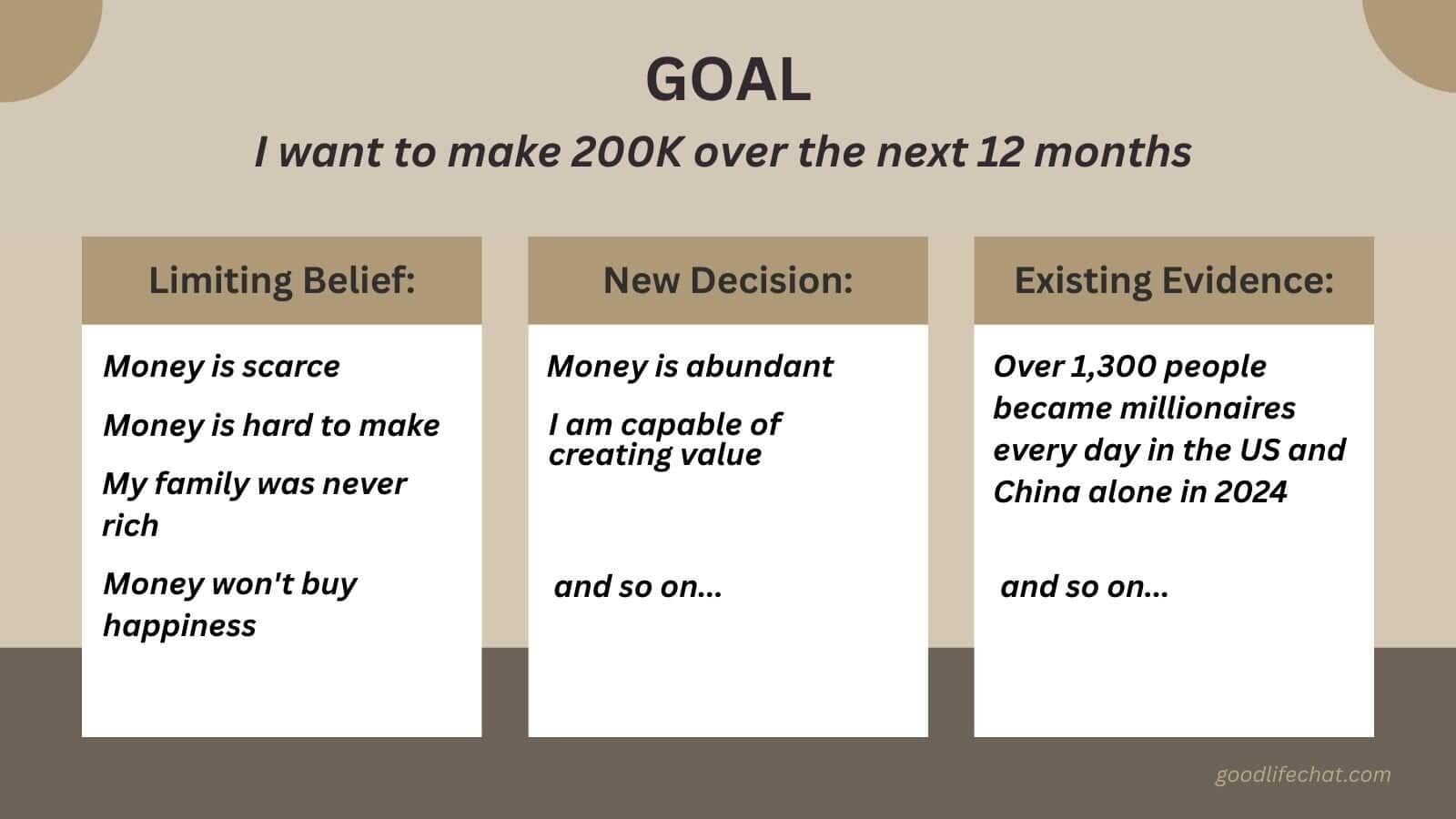
To make this process tangible, Bayer introduces what he calls a Decision Matrix, which you’ll see represented in the chart below. This chart includes an example of a goal to make 200K over the next 12 months.
Reframing New Year Resolutions From The Inside Out
The matrix works across three columns:
1. Limiting Beliefs
This column names the resistance surrounding a goal. These are not failures or flaws – they are simply beliefs that have been running quietly in the background.
Examples might include:
- Money is hard to make
- Money is scarce
- My family was never rich
- Money won’t buy happiness
The purpose here is awareness, not judgment.
2. New Decisions
Bayer reframes beliefs as decisions – often made unconsciously, sometimes long ago. And if beliefs are decisions, they can be revised.
For each limiting belief, we intentionally choose a new one that aligns with the life we want to create:
- Money is abundant
- I am capable of creating value
- Growth is available to me
These are not affirmations meant to override reality, but decisions that open a new lens through which reality is interpreted.
3. Existing Evidence
This final column anchors the process in lived experience. Instead of forcing belief, we look for evidence – personal, observed, or societal – that supports the new decision.
Evidence may include:
- Moments when things flowed more easily than expected
- Examples of others who created change later in life
- The sheer abundance of wealth already present in the world
As we do this, the mind begins to reorganize itself. Old assumptions loosen. New pathways form. Identity starts to shift.
From Resolution to Becoming
What emerges from this process is not a “better version” of ourselves through force, but a meaningful internal shift.”. When inner conflict resolves, behavior follows naturally. Action feels clearer. Discipline becomes less strained. Momentum arises without pressure.
In this way, New Year resolutions stop being about self-improvement and start becoming about self-alignment.
The invitation is simple but profound:
not just What do I want this year?
but Who am I deciding to be?
When that decision settles, the year ahead no longer needs to be pushed into shape. It unfolds – one resolved belief at a time.
P.S. For a lighter moment in this New Year series, there’s also a letter that gently pokes fun at our best-intended resolutions – and the many ways they tend to unravel.
*Feel free to share an excerpt with a link back. For full reposting, please contact me.